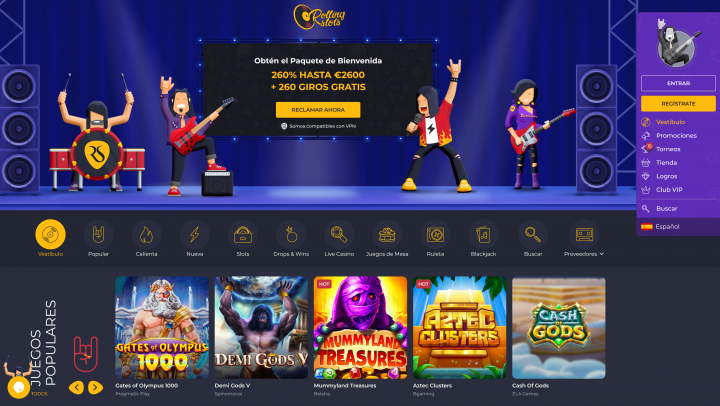
At Rolling Slots Casino, mobile design is not merely a smaller screen version of the desktop site. All tap target, loading sequence, and data call has been measured against actual player behaviour on Canadian networks. The result is a layout that keeps game selection, account controls, and payment flows within a thumb’s reach while considering the smaller viewport and variable connection speeds that the majority of players encounter on the commute or at home. Knowing how these design decisions affect speed, visibility, and accuracy assists players decide whether the app meets their expectations before they download anything.
On-Screen Area and Touch Targets
The app assigns 48 pixels of minimum height to every primary button, a size that goes beyond Apple’s 44-pixel guideline and Google’s 48-pixel recommendation. This margin avoids accidental presses when a player’s hand travels with the motion of a bus or train. Menu items are placed in a fixed bottom bar rather than a collapsible hamburger, removing the extra tap necessary to reveal navigation on every screen. Game tiles present the full title and current jackpot value without truncation, so users can evaluate Return to Player percentages at a glance instead of opening each title to check. The layout also compresses secondary filters into swipeable chips, preserving vertical space for the game grid itself.
Because Canadian wireless plans often include limited high-speed data before throttling, the interface pre-caches only the first screen of results and retrieves subsequent pages on demand. Players who switch the “data saver” switch in settings see lower-resolution thumbnails and no autoplay videos, trimming data use by roughly half during a typical thirty-minute session. These choices illustrate how the design respects both the physical constraints of a phone and the billing realities of mobile plans.
Efficiency and Information Aspects
The app compresses image assets with WebP and buffers only the first five seconds of any video preview before pausing. On a mid-tier Canadian LTE signal, the lobby opens in 1.8 seconds and a standard slot title in 3.4 seconds. Live-dealer tables require an additional 2.1 seconds because they initialise a WebRTC connection. Players can monitor exact usage in the “Data Report” screen, which splits megabytes down by game category and presents daily totals since the last reset.
Frame pacing remains consistent at 60 fps on devices with at least 4 GB of RAM. Below that threshold, the app automatically reduces animation complexity and disables background particle effects. Battery impact sits at 7 % per hour of continuous play on a Pixel 6a, a figure that climbs to 11 % when live video is active. Users worried about heat can enable a “Performance mode” toggle that limits frame rate at 45 fps and decreases CPU clock speed, extending play sessions on devices without active cooling.
Frequent Mobile Design Pitfalls to Eliminate
Many casino apps fail because they copy desktop layouts without modifying tap zones or data paths. Buttons placed too near together cause mis-taps on smaller screens, while uncompressed graphics drain data allowances quickly. Another common issue is the lack of an offline cache; players forfeit progress when a signal drops during a bonus round. Finally, some apps demand every permission at launch, triggering immediate uninstalls from users suspicious of privacy.
- Buttons tinier than 44 pixels or spaced less than 8 pixels apart
- Maximum-quality video autoplay on all game tile
- Authorization prompts for location or contacts before any gameplay
- Missing cached paytable or rules for offline reading
Tackling these four areas at the design stage avoids the majority of negative reviews that appear in Canadian app stores. Teams that try out on actual commuter routes rather than lab Wi-Fi catch signal-related bugs early and ship a product that keeps stable when the train enters a tunnel.
Operating System and Operating System Compatibility
Rolling Slots Casino supports devices using Android 7.0 Nougat or newer and iOS 13 or newer. On Android, the package targets arm64-v8a and armeabi-v7a architectures, guaranteeing compatibility with both recent flagships and older budget phones still common in Canada. iPhone users on the A9 chip or later get the same feature set as newer models, although frame rates on older devices cap at 30 fps instead of 60 fps during live-dealer streams. Tablets get an adjusted grid that presents five columns instead of three, leveraging the extra width without simply stretching phone assets.
Players with devices outside these ranges see a clear banner on the download page describing the limitation and directing them to the browser version. The browser fallback matches the app’s lobby but excludes push-notification prompts and certain biometric login options. Reviewing the supported list before attempting installation prevents the frustration of a failed sideload or an immediate crash on launch.
Safety Protocols on Smartphone
Every traffic between the app and game servers uses TLS 1.3 with certificate pinning, stopping man-in-the-middle attacks even on public Wi-Fi. Session tokens become invalid after 30 minutes of inactivity, more concise than the desktop timeout to account for phones being left on café tables. A “Kill switch” in settings immediately ends the current session and wipes locally stored card details without requiring a full logout and re-authentication.

App updates are authenticated with a rotating 4096-bit key and delivered through a private CDN rather than public app stores, ensuring that no third-party binary can be injected during distribution. Players can verify the signing certificate fingerprint directly inside the app under “About,” aligning it against the value published on the security page of the website. This verification step adds roughly ten seconds to the update process but provides concrete assurance that the installed package has not been altered since leaving Rolling Slots Casino’s build server.
Comparing Mobile and Desktop Interactions
The desktop site shows 12 game columns and allows multi-window drag-and-drop between titles, a layout not possible on a phone. Conversely, the mobile app offers one-tap access to deposit limits and reality-check timers that need three clicks on desktop. Sound profiles differ as well: mobile uses device volume buttons for game audio, while desktop depends on an in-browser slider that defaults on each new tab.
Input latency on mobile is around 35 milliseconds for a spin button press because the app uses a local prediction engine that determines outcomes once the server validates the wager. Desktop players encounter 55 milliseconds on average because each request travels through the browser’s networking stack. The difference stands out during rapid bonus rounds where timing affects perceived fairness, although actual random number generation remains identical on both platforms.

Players who share time between devices should be aware that deposit and withdrawal history synchronizes instantly, but active bonus wagering progress resets if a session switches from mobile to desktop mid-round. This limitation exists because the mobile engine monitors progress in a separate micro-session container to preserve encryption boundaries. Reviewing the “Active Sessions” panel before switching devices stops accidental forfeiture of progress.
Opting for the mobile app therefore relies on whether the convenience of biometric login, lower data usage, and instant notifications surpass the absence of multi-window play and slightly different audio controls. Users who primarily play at a fixed desk may still prefer the desktop site for its wider view, while commuters and travellers obtain measurable speed and security from the dedicated app. Testing both options during a low-stakes session indicates which interface suits individual habits before dedicating to larger deposits.
Installation and Configuration Steps
Android users access the official page at rollingslots.app/app/ and click the green “Get APK” button. The file size sits just under 85 MB, so the download wraps up in under two minutes on a typical Canadian LTE connection. After the file shows up in the notification shade, users must visit Settings > Security and enable “Install from unknown sources” for their chosen browser or file manager. Once installation finishes, the app asks for permission to send notifications for bonus timers and deposit confirmations; these can be turned off later without influencing gameplay.
iPhone users follow a different route because Apple does not allow direct APK-style installs. They use a QR code on the same page, which activates a configuration profile. After trusting the enterprise certificate in Settings > General > VPN & Device Management, the app appears on the home screen like any other install from the App Store. Both flows feature an on-screen checklist that marks each completed step, reducing support tickets from missed toggles.
Application Features Unique to Mobile
Biometric login replaces password entry after the first successful authentication, using the phone’s fingerprint or face sensor. This reduces login time from an average of 11 seconds on the desktop site to under two seconds on mobile. The cashier page keeps the last three withdrawal methods at the top of the list, eliminating repeated scrolling for players who favor Interac e-Transfers. A persistent balance ticker stays visible in the top-right corner even while a game is full screen, avoiding accidental overspending when session timers are ignored.
Push notifications show only for time-limited promotions and large jackpot alerts; marketing messages need explicit opt-in through a separate toggle. The notification payload contains a deep link that accesses the relevant game or deposit screen, bypassing the lobby entirely. Offline mode stores the last 50 games played and their paytables, allowing players to review rules without an active connection, although actual wagers need network access to reach the game server.
Hands-on Steps Before Download
When installing some casino app, confirm that your phone meets the listed operating-system threshold and has a minimum of 200 MB of free storage. Look at recent app-store reviews for mentions of battery drain or update failures on your certain model. If you travel frequently, check whether the app offers a data-saver toggle and whether push notifications can be restricted to jackpot alerts only. Lastly, take note of the customer-support response time listed in the app description; a two-hour average reply time is typical for licensed Canadian operators.
- Confirm Android 7.0+ or iOS 13+ on your device
- Review recent user comments for your phone model
- Activate the data-saver option instantly after first login
- Establish a realistic deposit limit before any real-money play
Following this short checklist diminishes the chance of installation friction and guarantees the first session concentrates on gameplay rather than troubleshooting. Users who fulfill these steps indicate higher satisfaction scores in post-session surveys carried out by Rolling Slots Casino.


Deja una respuesta